Monday, March 31, 2008

Sea tiger base bombed: Mullaithiv

Sri Lanka Air Force fighter jets bombed a sea tiger base located in Alampil in LTTE stronghold of Mullaithiv district yesterday. The raids which were made yesterday afternoon, are reported to be accurate. No casualty details are available as of yet. The Air Force has shown more activity in the past week with its fighter jets and gunships both assisting the ground forces, even amidst bad weather conditions.

Meanwhile continuous rain in Mannar has greatly affected the ongoing operations by the army. The flood like situation and soggy ground conditions have made the deployment of armored vehicles near impossible. Ground forces advance has also slowed down as trenches dug and death traps set by the LTTE are now covered with water and are not easily visible. However against all odd the army captured LTTE controlled Ilantheevan, located to the south of Adampan junction on the 29th.

Meanwhile more than 500 soldiers have so far fallen to Chikengunya and Dengu diseases due to the worsening sanitary conditions in the front lines affected by rain. Necessary steps are being taken to prevent the spread of such diseases and reserve forces have been deployed in the affected areas.

Around two weeks ago Military Intelligence received fresh intel on the massive trench that is been dug in the northern FDL to stop the Mechanized Infantry Brigade which the tigers apparently consider to be a great threat. The multi layered trench complex with iron fences and reinforced concrete are supposed to not only stop the heavy armor from storming tiger defenses but the tigers are also planning to capture any vehicles that fall into them. Mechanized Infantry brigade has changed its strategy and future plans based on the new intel.

Friday, March 28, 2008

SLAF attacks 4 LTTE targets in two days

The Sri Lanka Air Force (SLAF) has carried four sorties on LTTE targets located in the northern province during the past two days (26th and 27th). An LTTE training facility located in jungles north of Iranamadu and an LTTE radar post south of Pooneryn was raided by bombers of the SLAF 10th fighter squadron and 5th jet squadron yesterday (27th) morning . Bombers also raided an LTTE boatyard in Vishwamadukulam, Kilinochchi on the 26th.

Meanwhile in the Mannar front. two Mi-24 helicopter gunships of the 9th attack helicopter squadron assisted the ground forces by launching a series of attacks on LTTE positions in the region. Two forward operating bases in Alankulama and Kaliadanchan were attacked by the gunships.Forward Operating Bases (FOB) are secured positions on or near the Forward Defence Line (FDL) which are used for support role.

Meanwhile 32 LTTE cadres have been killed in fighting in Mannar, Weli-Oya and Jaffna fronts which took place on the 26th. Another 18 more are believed to be wounded. 8 Army soldiers too have been killed and 21 more have been wounded in the clashes.

Tuesday, March 25, 2008

SLAF bombs Mullaithiv

Sri Lanka Air Force (SLAF) fighter jets bombed an LTTE military installation located in Uddayak-Kattukulama, Mullaithiv today at 9.20AM. The raid was carried out following military intelligence reports of LTTE maintaining an ammunition storage at the target location. Although fighter pilots have confirmed accurate hits on the target, exact details on damages caused to LTTE assets or lives are not available as of now.

Meanwhile intelligence reports from LTTE held Wanni indicated that  3 LTTE cadres have been killed and 8 more injured when SLAF bombed a sea tiger base north of Nayaru lagoon on the 22nd.

Monday, March 24, 2008

Heavy fighting in Mannar amidst bad weather

Despite continuous rain, the Sri Lanka Army (SLA) and the Liberation Tigers of Tamil Eelam (LTTE) have been engaged in firefights in the Mannar front for the last few days. Heaviest fighting was reported in the area between Parayakulam and Illanthevan where the troops gained control of around 1 square km area last Saturday (24th).

Pro LTTE media put SLA casualty figures at 55 killed and 120 injured. Our sources flatly deny these claims. The actual SLA casualty figures are less than one third of what is claimed by Pro LTTE Tamilnet.com site. In Parayakulam, 8 LTTE bunkers were overrun during the fighting. Bodies of 10 LTTE cadres which had been left behind when the tigers pulled back from the bunkers were later found by the army. Fighting was also reported in Vavuniya, Weli Oya and Nagarkovil fronts. For the last three days, total confirmed LTTE deaths incurred from fighting at these three fronts exceed 40. At least 5 of the kills were made by army snipers deployed at northern front and at Weli Oya front. The number of LTTE injured is not exactly known.

Mannar front is probably the most affected by the recent rains. Army operations in this area will be reduced until the weather improves. There are many threats posed by the continuous rain; The wet and muddy ground is a nightmare for armored corps. Maneuverability of heavy vehicles becomes much more difficult in soggy ground. In addition to this, it is near impossible to detect enemy trenches and deathtraps if the area is flooded by water; this is lethal to vehicles and soldiers alike. Usually, the locations where mines are placed are mapped by the party which places them. However, if the rains are heavy, the gushing water could change the location of buried mines. If this happens, the whole mining and mapping process will have to be repeated. Last but not least, flooding is bound to worsen the sanitary conditions in the affected area. This can cause the spreading of water borne diseases.

Note: When the comment count exceeds 200, blogger automatically places new comments in a new page. Click on the "Newest" link in top or bottom of the comments sections to read latest comments.

Ex-

clip_image001[10]

Saturday, March 22, 2008

SLN loses UFAC in the seas off Nayaru

One Ultra Fast Attack Craft (UFAC) of the Sri Lanka Navy (SLN) was destroyed today dawn in an explosion that occurred near the seas off Nayaru coastline. 10 sailors on board have gone missing after the incident. 6 more who were on board have been rescued by another FAC deployed in the area. The rescued personnel which included the officer in charge of the craft had managed to get into a life boat before it submerged.

The source of the explosion is not 100% confirmed as of yet. According to the rescued sailors, the craft was rocked by a blast that severely damaged its hull. However pro LTTE media reported that the UFAC was destroyed in a suicide attack and admitted the loss of 3 suicide cadres.

Military intelligence had previously uncovered that Norwegian ex special forces members provided underwater demolitions training to LTTE cadres in Thailand. In addition to this information it is suspected that LTTE smuggled in a few underwater scooters during the ceasefire period. Additionally, LTTE are known to use several different types of sea mines including floating mines.

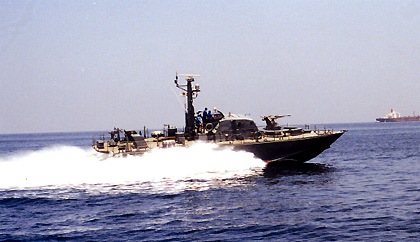
UFAC-3_DNT

Image: SLN UFAC - III

The craft destroyed is an UFAC- III type vessel which is commonly known as Colombo Class Series III. It can achieve speeds up to 53 knots and can carry a crew of 16. Typhoon 25-30mm cannons, Oerlikon 20mm cannons, 12.7mm machine guns and 7.62mm machine guns can be mounted on a UFAC-III. However not all SLN FACs are fitted to their full potential.

Meanwhile Sri Lanka Air Force hit a sea tiger base north of Nayaru lagoon today morning. No reports of damages caused by the air raid are available as of now.

In the Mannar front, troops have gained control of a 1 square kilometer area between Parayakulam and Illanthevan amidst bad weather conditions. Continuous rains have slowed down military operations in the area, a situation which was expected.

Friday, March 21, 2008

STF commando killed in LTTE attack : Ampara

One police Special Task Force (STF) personnel was in a clash between LTTE and STF in Lahugala jungle, Ampara, yesterday. Both parties exchanged small arms fire in the clash which began at around 11.30 in the night. The STF personnel who was critically injured in the incident, succumbed to his injuries in Ampara hospital. There are no reports of LTTE casualties.

Meanwhile Sri Lanka Army (SLA) soldiers deployed in the Mannar front continued to carry out limited offensives against LTTE targets in Adampan and Munakkathirichchi regions while braving bad weather conditions. Of all the SLA elements affected by bad weather, perhaps the worst affected are the armored corps. Heavy armor such such as infantry fighting vehicles and battle tanks are difficult to maneuver in soggy ground conditions created by continuous rain.

In Weli-Oya front troops of the army's 59th division engaged LTTE targets in Kokkuthuduvai and Andankulama regions, killing at least 7 LTTE cadres.

Meanwhile the Pilleyan faction of TMVP has requested removal of  all STF camps in eastern province before the provincial council elections.

Wednesday, March 19, 2008

Tigers shell Thirukkeatheesvaram : Mannar

Liberation Tigers of Tamil Eelam (LTTE) directed a heavy artillery barrage at SLA controlled Thirukkeatheesvaram in Mannar. Thirukkeatheesvaram is inside the High Security Zone declared by the army. However DefenceNet learns that reports by pro LTTE media which claimed the Forward Defence Lines in this region being broken were inaccurate. Also, there were no ground clashes in the area despite the artillery duels. Thirukkeatheesvaram is located near SLA's Thalladi army base which the tigers targeted in a previous shelling.

Fighting however was reported in areas north of Pallekuli yesterday morning. At least 6 LTTE cadres were reported to be killed in the incident. 4 SLA soldiers too were injured. Two LTTE bunkers were overrun during fighting.

Meanwhile an SLA soldier was killed in a roadside claymore mine explosion in Ka'limoaddai, Mannar.

Monday, March 17, 2008

Historic Battles : Battle for Elephant Pass - 1991

This is the first of a series of articles revisiting the most decisive battles of the Eelam Wars.

As most of you know, Operation Balavegaya was not an operation that was aimed at capturing new territory. It's main objective was to save the lives of 800 army personnel who were trapped in army's Elephant Pass Base Complex (EPS), under siege by LTTE formations.

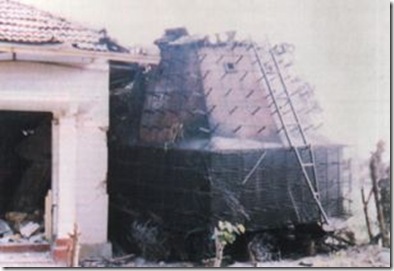
Unlike in the early 2000s, EPS garrison did not include thousands of army soldiers. It only had 800 men from the Sinha Regiment (SR). On the 10th of July 1991, a 5000 strong LTTE force (approximate number) launched a large scale attack on EPS base complex. Not only was the invasion force massive in numbers, LTTE had planned the attack to perfection. Anti aircraft guns were strategically placed so that no helicopter could land in supplies nor evacuate casualties from the base.  Armor plated bulldozers fitted with machine guns and armor plated tractors were used break through the army lines with LTTE minimum casualties. Not only did they broke through SLA defenses but the sinister looking bulldozers sent the morale of the defenders to an all time low.
EPS_BULLDOZER_GK_DNT

Image: Armor plated Bulldozer used by LTTE in EPS battle. Corporal Gamini Kularathne (PWV) destroyed the machine using two hand grenades when it tried to break into the inner part of the base. Corporal Kularathne succumbed to injuries suffered during the incident. 

Unlike today, the army did not have a clear answer to LTTE's 'human waves' strategy back then. Wave after wave of LTTE cadres pounded the camp's southern defence lines while LTTE mortars rained into the base premises. LTTE forces which outnumbered the garrison in EPS 6 to 1, were meeting with unexpected resistance from the SR soldiers defending the base. Although the soldiers were holding off the LTTE in the southern front, the situation was looking grim for SLA in the long term due to lack of supplies and inability to transport casualties.

During the second day of fighting, the smaller 'Rest House Camp' to the south of the base complex fell the the LTTE. By this time, Major Lalith Buddhadasa who was the second in command of the base had also died due to shrapnel injuries received from an LTTE mortar.  Due to the strategic placement of LTTE's AA cannons, SLAF could not land in any helicopters. The only help SLAF could offer the defending soldiers was to air drop supplies into the base. Although majority of the supplies fell into the base as planned, some were retrieved by the LTTE.

After four days of bitter fighting, LTTE forces showed no signs of slowing down. This was when (14th of July) Major General Densil Kobbekaduwa and Brigadier Wijaya Wimalarathna launched operation Balavegaya. Operation Balavegaya, which involved 10000 SLA troops, was the largest army operation at he time since Operation Vimukthi. 1 Sinha Regiment (SR), 3,4 Gajaba Regiment (GR) and 3 Sri Lanka Light Infantry (SLLI), Sri Lanka Artillery and Armored corps were the formations that took part in the operation.

Since there was no clear land route to EPS from government controlled territory, it was decided that an amphibious landing was necessary. A location some 10km to the east of EPS (Vettilakarni) was chosen as the landing point. LTTE which had early information on the army's move, resisted the amphibious landing fiercely. The first attempt to land troops failed as a consequence. However it was a matter of time till the army secured Vettilakarni under the command of Major General Vijaya Wimalarathna. Vettilakarni was then used as a launching pad for the march towards EPS.

The LTTE which had the territorial advantage continued to resist the army advance. This however eased the pressure on EPS, although the base was still in danger of being overrun. Fighting continued for 17 more days in this fashion, with LTTE put on the defence and SLA backed by SLAF trying to reach EPS. Finally, on the 3rd of August at approximately 5PM, vanguard of Operation Balavegaya reached Elephant Pass Base premises. A combined effort of the relief force and the SR soldiers in EPS garrison saw the LTTE retreat their fighters and thus siege which the LTTE leader had nicknamed 'Mother of All Battles" was broken. This was considered as the best victory by the armed forces until the capture of Jaffna.

Although the battle was won, it wasn't without casualties; a total of 200 soldiers had given their lives for the motherland during the entire battle. More than 500 others were injured. LTTE casualties on the other hand were much higher. According to LTTE released figures the number of LTTE deaths was 573 (450 male and 123 female). But well informed sources suggested that number of LTTE fighters killed was well over 800. A similar number was said to be injured.

EPS remained under SLA control for 9 more years after the initial incident. In 2000, the poorly lead and demoralized 54th division in EPS made a tactical withdrawal in the face of another LTTE siege and the base has since been under LTTE control. According to MI, LTTE does not maintain one major base at EPS but have built a series of smaller bases to better face an army advance. Army's 55th and 53rd division, which are now lead by true veterans, are currently probing rebel defence lines in the north showing the signs of an advance into Wanni in near future.

Saturday, March 15, 2008

Army recovers 3 LTTE bodies: Weli Oya

Soldiers of the 59th division confronted with a group of LTTE cadres north of Janakapura (Anandamkula) Thursday evening. An LTTE bunker was stormed by the soldiers during the fight, resulting in the death of 3 LTTE cadres. Two T-56 rifles, three hand grenades and a radio unit were found by the troops after a search operation in the area. Bodies of the 3 LTTE cadres killed were also recovered.

Clashes were also reported in Vavuniya in Karampaikulam and Vilayanikulam regions. 2 more LTTE bodies have been recovered by the troops following in the incidents. Two T-56 rifles were also recovered.

Meanwhile yet another valiant soldier of the army fell to an LTTE AP (Anti personnel) mine in the Mannar front on Tuesday (11th). SLA Captain Keerthi Ranawaka passed away at the hospital, due to the serious nature of his injuries caused by the mine. Majority of SLA casualties in Mannar front are caused by AP mines, which have also slowed down the advance into Wanni.

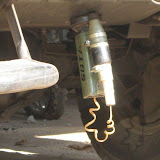
Images: Magnetic Bomb

With recent findings by the Military Intelligence (MI), there has been renewed interest on the so called magnetic bomb.

Click on the image to view entire collection.

Magnetic_Bomb


This is not an entirely new technology as a similar type of bomb was used to blast the vehicle of a VIP few years ago. However the bomb seems to have been improved over time. The 'easiness' of planting this bomb onto a vehicle with an unsuspecting driver, is alarming. Recent discovery of a magnetic bomb coupled with the recent uncovering of an LTTE plot to blow up a fuel tanker, only calls up for more vigilance among civilians.